
February 9, 2023
Over the last two decades of working closely with feed mills, integrators, and progressive livestock producers, I’ve encountered a recurring challenge: using one mineral premix across multiple species.
What seems convenient in theory often leads to performance loss, health complications, or even toxicity in practice.
Each species — whether ruminant, monogastric, aquatic, or companion animal — has unique digestive physiology, absorption capability, and mineral tolerance. That’s why, at ReproDumix, we strongly advocate precision-formulated, species-specific premixes for optimal health and productivity.
The Science Behind Species-Specific Nutrition
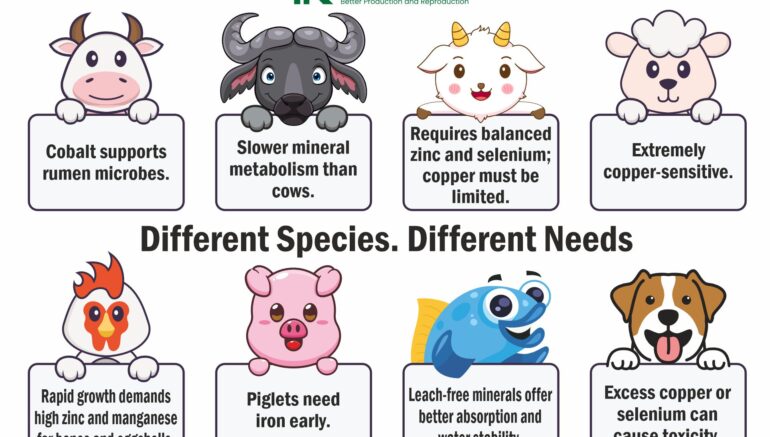
Animals differ not only in size but in how they digest and utilize nutrients. Here are just a few examples:
🐄 Cattle (Ruminants)
Cattle rely on *rumen microbes, which require *cobalt to synthesize vitamin B12 — essential for energy metabolism. They can tolerate moderate levels of copper, unlike sheep.
🐃 Buffalo
Buffaloes have slower mineral metabolism than cows and often require adjusted phosphorus and trace mineral levels to support lactation and reproductive health.
🐐 Goat
Goats need balanced zinc and selenium for immunity and reproductive function. However, copper must be monitored to avoid long-term accumulation and toxicity risk.
🐑 Sheep
Sheep are *highly copper-sensitive. Using cattle or goat premixes can result in *fatal copper toxicity. Their selenium and cobalt requirements are also lower.
🐔 Poultry
Broilers and layers have *high growth rates and rapid turnover, requiring elevated levels of *manganese, zinc, and iodine for skeletal strength and eggshell quality. Using ruminant premixes here leads to deficiencies or imbalances.
🐖 Swine
Piglets are born with low iron reserves and must be supplemented early to prevent anemia. Swine also benefit from specific levels of zinc and copper for gut integrity and growth — very different from poultry or ruminant needs.
🐟 Aqua (Fish/Shrimp)
Aquatic species absorb minerals *directly from water and feed, so mineral form and solubility are critical. *Leach-free and chelated minerals offer better stability, palatability, and absorption in aquatic systems.
🐶 Pets (Dogs & Cats)
Dogs and cats have *very narrow mineral tolerance ranges. Even trace excesses of **copper or selenium, commonly used in livestock premixes, can be *toxic. That’s why companion animals must always receive species-specific formulations.
Why Using the Wrong Premix Is Risky
Here are a few real-world risks of using non-specific or misapplied mineral blends:
- Copper toxicity in sheep from cattle premix
- Iron-deficiency anemia in piglets due to lack of targeted supplementation
- Poor shell quality in poultry when manganese levels are inadequate
- Underdosing or overdosing selenium in pets due to inappropriate cross-species use
- Trace mineral leaching in fish ponds, reducing feed efficiency and water quality
ReproDumix Approach: Precision by Species, Not Assumption
At ReproDumix, we follow three guiding principles in premix formulation:
✅ 1. Species First, Always
Every formula starts by understanding the animal’s physiology, lifecycle stage, and performance goal.
✅ 2. Bioavailability Matters
We use chelated and protected mineral sources where absorption and interaction matter most — especially in aquaculture, poultry, and high-yielding dairy systems.
✅ 3. Formulation Backed by Field Data
We blend science with on-ground insights to ensure practical, profitable outcomes for the farmer.
Final Thoughts
There’s no shortcut to animal health and feed efficiency. Precision premixing isn’t about adding more — it’s about adding right.
After 20 years in the field, one fact stands clear:
You can’t apply the same premix across species and expect the same results.
Whether it’s a cow, a shrimp, or a dog — nutritional precision is the foundation of performance, health, and profitability.
📞 Need Help Choosing or Customizing a Premix?
Talk to the ReproDumix Technical Team.
We help feed manufacturers, integrators, and farms build species-specific, science-based solutions that perform in the real world.